
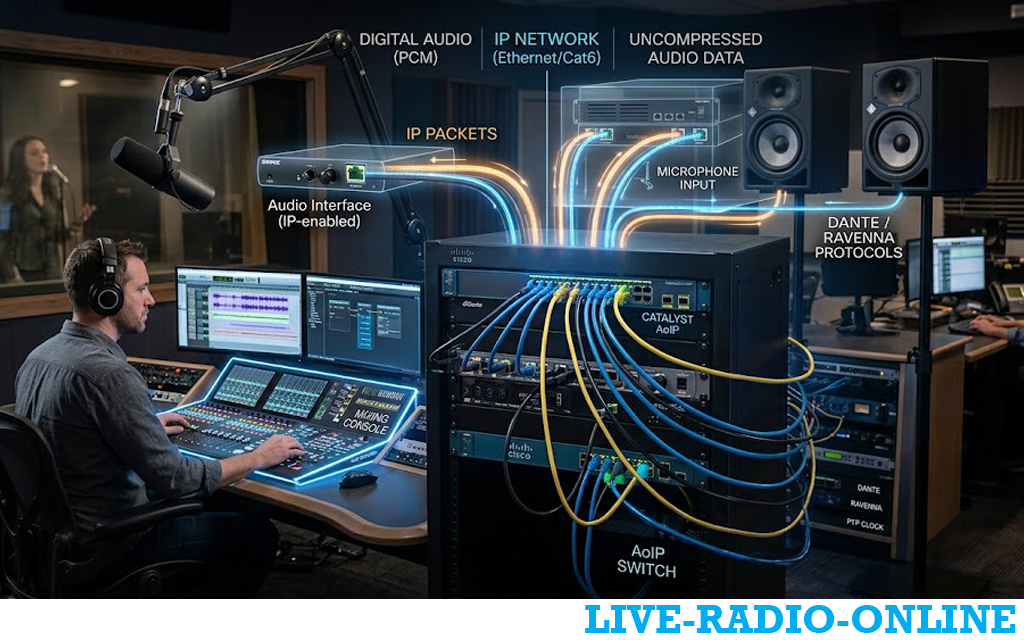
Dante is not an open standard like AES67; rather, it is a proprietary Audio over IP (AoIP) networking technology developed by the Australian company Audinate. It has become the de facto industry standard for transporting high-quality, uncompressed digital audio over standard Ethernet networks, with over 4,500 products available from more than 700 manufacturers worldwide.
Core Technology and How It Works
Dante replaces point-to-point analog and digital audio cables with a standard IT network. Key technical features include:
- High Performance & Low Latency: It uses standard Gigabit Ethernet to transmit hundreds of channels of uncompressed audio with ultra-low, sample-accurate latency (typically under 1 millisecond). It relies on Precision Time Protocol (PTP) to synchronize all devices on the network.
- "Auto-Discovery": One of Dante’s hallmark features is automatic device discovery. When you connect a Dante-enabled device to a network, it is instantly recognized by the control software (Dante Controller), which allows engineers to route audio between devices using a simple drag-and-drop interface.
- Software Configuration: Complex audio routing that once required physical patch bays is now managed entirely via software, allowing signals to be routed dynamically across studios, control rooms, or remote locations without changing a single cable.
How Dante Fits Into the AoIP Ecosystem
While Dante is proprietary, it has evolved to work with open standards to ensure interoperability:
- Relationship with AES67: AES67 is an open interoperability standard that allows different AoIP protocols (such as Dante, Ravenna, and Livewire) to communicate. Dante supports AES67, meaning you can configure Dante devices to send and receive audio to and from non-Dante devices that also support AES67.
- Broadcast Standards (ST 2110): Audinate has expanded Dante to support SMPTE ST 2110-30, the suite of standards for professional media over IP in broadcast environments. Recent updates allow engineers to configure ST 2110 and AES67 streams directly from the Dante Controller software, bridging traditional Dante audio networks with video-over-IP systems.
Comparison with Other Standards
| Feature | Dante (Audinate) | AES67 (Open Standard) | RAVENNA (Open Standard) |
|---|---|---|---|
| Status | Proprietary (Market Leader) | Open Interoperability Standard | Open Source (No License Fee) |
| Ease of Use | High ("Auto-Discovery", Drag-and-Drop) | Moderate (Requires manual setup) | Moderate |
| Licensing | Manufacturer pays fee; passed to user | Free | Free |
| Key Feature | Seamless integration of hundreds of devices | Allows different protocols to talk to each other | High sample rate support (up to 384kHz) |
Management and Scalability
For large-scale installations, Audinate offers the Dante Domain Manager. This is a centralized network management solution that adds IT-level controls to Dante networks, including user authentication, role-based security (who can plug in a microphone and who can change the main studio routing), and the ability to traverse subnets and manage multiple rooms or buildings from a single interface.
In summary, while AES67 is the "translator" that allows different systems to talk, Dante is the dominant "language" used by most professional audio devices because of its ease of use, reliability, and powerful management tools.